

Spiritual Connection with Nature — Why Nature Quietly Awakens the Human Spirit
Many people feel an immediate sense of calm when they step into a forest, stand beside the ocean, or walk across an open field. The body relaxes. The mind slows down. Something subtle shifts within awareness. This response is not accidental.
Human beings have always maintained a spiritual connection with nature. Long before modern philosophies emerged, ancient traditions understood the Earth as a living environment that nourishes consciousness as much as it sustains physical life.
Today, however, many people experience nature only as scenery. It becomes a place to visit rather than a presence to engage with. As a result, the deeper dimension of this relationship remains largely forgotten.
Yet whenever someone spends time in silence beneath trees or near moving water, the same pattern appears. Thoughts soften. Perception widens. A quiet awareness replaces the constant pressure of modern life.
For centuries, mystics and spiritual teachers recognized this phenomenon. Mountains, deserts, forests, and rivers were never chosen randomly as places of retreat. They were environments where the human mind naturally returned to clarity.
Understanding the spiritual connection with nature therefore reveals something profound. Nature does not simply surround human life. It helps awaken it.

The Ancient View of Earth as a Living Presence
Early civilizations rarely viewed the Earth as an inert landscape. Instead, nature was experienced as a living system filled with intelligence and meaning.
Indigenous cultures across the world treated rivers, mountains, and forests as sacred presences. Rituals expressed gratitude toward the land because survival depended on balance rather than domination. Within those traditions, humanity was not separate from the environment. It was an expression of it.
Eastern philosophies expressed a similar understanding. In Taoist thought, the natural world embodies harmony through effortless flow. Observing rivers or wind through trees reveals how life moves without force. Wisdom emerges by aligning with that rhythm.
Even early Western mystical traditions acknowledged this relationship. Hermetic teachings described the universe as an interconnected whole in which human consciousness reflects larger natural patterns. The famous phrase “as above, so below” captures that correspondence.
Across cultures, therefore, a shared insight appeared repeatedly. The Earth was not merely matter. It was a field of living intelligence capable of teaching those willing to observe.
This perspective formed the foundation for humanity’s enduring spiritual connection with nature.
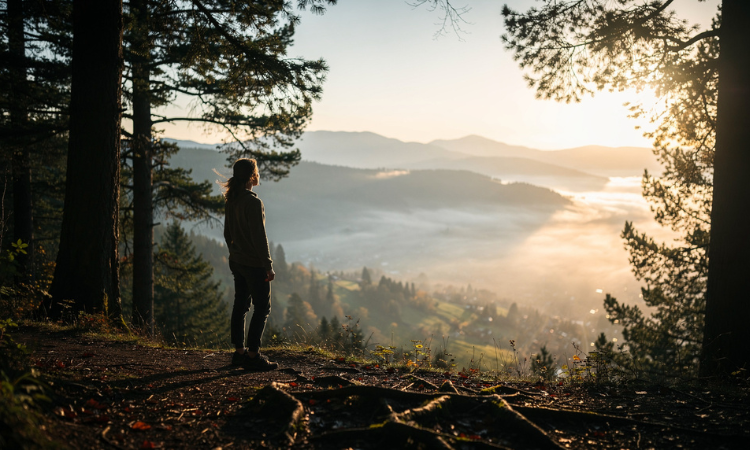
Why Nature Awakens Human Consciousness
Modern science often explains the calming effect of nature through psychology or biology. Fresh air, natural light, and open spaces certainly benefit the body. Yet those factors alone cannot fully explain the deeper experience many people report.
Something else happens when individuals spend time in natural environments.
First, nature operates without constant stimulation. Modern cities bombard the senses with noise, movement, and artificial signals. In contrast, forests and landscapes move at a slower rhythm. This quiet pace allows the mind to settle.
Second, natural environments contain patterns the human brain instinctively recognizes. Waves, leaves, clouds, and seasons follow repeating cycles. Observing these rhythms gradually restores internal balance.
Third, nature invites attention without demanding it. A bird crossing the sky or wind moving through grass captures awareness gently. Instead of pulling the mind outward, it allows perception to expand.
Because of these conditions, the spiritual connection with nature often awakens awareness naturally. The mind does not struggle to become quiet. Silence appears on its own.
In that silence, people frequently encounter a deeper sense of presence. Thoughts become less dominant. Awareness widens beyond personal concerns.
This subtle shift marks the beginning of inner awakening.

The Forgotten Language Between Humans and the Earth
Although the modern world rarely speaks of it, humans once maintained an intuitive dialogue with the natural world.
Farmers understood the rhythm of seasons by observing subtle changes in weather and soil. Travelers read landscapes to navigate terrain. Communities interpreted bird behavior, wind patterns, and celestial movement as signs guiding daily life.
This sensitivity formed a quiet language.
Unlike spoken communication, the language of nature operates through observation and presence. The Earth does not speak in words. Instead, it reveals patterns.
Clouds gathering along the horizon signal approaching rain. Trees leaning toward sunlight demonstrate the movement of life toward growth. Rivers carving valleys illustrate persistence over time.
When people slow down enough to notice these patterns, perception deepens. The spiritual connection with nature becomes experiential rather than conceptual.
Modern lifestyles often dull this sensitivity. Constant screens and artificial environments pull attention away from natural rhythms. However, the ability itself never disappears. It simply waits to be remembered.
By returning regularly to natural settings, individuals gradually rediscover this subtle dialogue. Awareness becomes more attentive. Presence becomes more stable.
Nature does not force this reconnection. It quietly invites it.

The Spiritual Intelligence of Natural Cycles
Nature also teaches through its cycles. Every ecosystem demonstrates continuous transformation.
Seeds disappear beneath soil before new plants emerge. Leaves fall each autumn before trees grow again in spring. Even mountains slowly reshape through erosion and time.
These processes mirror human experience. Growth often requires letting go. Renewal follows endings. Transformation rarely occurs instantly.
Observing such patterns helps dissolve the illusion that life should remain static. Instead, nature reveals that change forms the foundation of stability.
This realization strengthens the spiritual connection with nature. Human struggles no longer appear isolated or meaningless. They become part of larger cycles unfolding across existence.
For many spiritual traditions, this understanding shaped profound insights. Death and rebirth became symbols of transformation rather than loss. Patience replaced urgency. Acceptance replaced resistance.
Nature quietly demonstrates that evolution unfolds through rhythm rather than force.

Why Mystics Always Return to Nature
Throughout history, individuals seeking deeper awareness often withdrew into natural environments.
Buddha meditated beneath a tree. Desert fathers entered remote landscapes. Taoist sages retreated into mountains. Christian mystics walked forest paths in silence.
These choices reflected more than preference. Natural settings remove many distractions that reinforce identity and social roles.
Without constant interaction, attention naturally turns inward. Silence becomes accessible. Awareness expands.
At the same time, nature provides grounding. The simplicity of wind, earth, and water stabilizes perception. Instead of feeling isolated, many people report a sense of belonging within a larger living system.
For this reason, the spiritual connection with nature has long supported contemplative practice. The environment itself encourages reflection without imposing doctrine.
Nature does not instruct through authority. It teaches through presence.

Relearning How to Listen to the Earth
Rebuilding a relationship with nature does not require dramatic changes. Often it begins through simple observation.
Walking quietly through a park or forest can restore awareness. Sitting near water allows thoughts to slow. Watching the movement of clouds reveals how life flows without tension.
These small moments gradually reawaken sensitivity.
Instead of treating nature as background scenery, individuals begin recognizing it as a living context. Attention shifts from constant thinking toward quiet perception.
Over time, the spiritual connection with nature deepens. Awareness becomes less reactive and more grounded. People begin noticing subtle shifts in mood, energy, and clarity after spending time outdoors.
This reconnection does not depend on belief systems. It arises through direct experience.
Nature simply provides the environment where presence becomes easier.

Spiritual Connection with Nature — Awakening Through the Living Earth
Nature has never stopped speaking. The challenge lies in whether human awareness remains quiet enough to listen.
When individuals rediscover their spiritual connection with nature, perception begins to change. Life appears less fragmented. The boundary between observer and environment softens.
Instead of feeling separate from the world, people sense participation within a larger living process.
This recognition forms a quiet awakening.
Nature does not impose teachings or demand devotion. It simply reveals patterns of balance, patience, and transformation. Those who observe carefully begin to recognize the same principles operating within themselves.
In that moment, the Earth is no longer merely a landscape surrounding human life.
It becomes a mirror reflecting the deeper rhythm of existence.

FAQ SECTION
Why do people feel calmer when they spend time in nature?
Natural environments reduce sensory overload and restore internal balance. The rhythms of wind, water, and natural light help quiet mental activity, allowing awareness to expand.
Can nature really influence spiritual awareness?
Yes. Many spiritual traditions believe that natural environments encourage reflection and presence. Mountains, forests, and oceans create conditions where consciousness becomes calmer and more attentive.
Is the spiritual connection with nature part of ancient traditions?
Many ancient cultures viewed the Earth as a living system rather than a resource. Indigenous traditions, Taoist philosophy, and early mystical teachings all emphasized harmony with natural rhythms.
Do you need to live in the wilderness to reconnect with nature?
No. Even small experiences—walking through a park, observing trees, or sitting near water—can restore awareness of nature’s rhythms.
Why did many spiritual teachers spend time in nature?
Natural environments remove distractions and help individuals experience silence and reflection. This allows deeper awareness to emerge without external pressure.