

Life and Teachings of the Masters of the Far East review
Some books arrive with attention. Others move quietly, passed from one reader to another without promotion or visibility.
Life and Teachings of the Masters of the Far East belongs to the second category.
For decades, this series has circulated outside the mainstream.
It rarely appears in academic discussions. It is not widely referenced in institutional spirituality.
Yet it continues to reach readers who describe a similar response: a sense that something within the text feels familiar, direct, and unusually clear.
This quiet persistence raises a question.
Why do these books endure without formal recognition, while many others fade despite greater exposure?
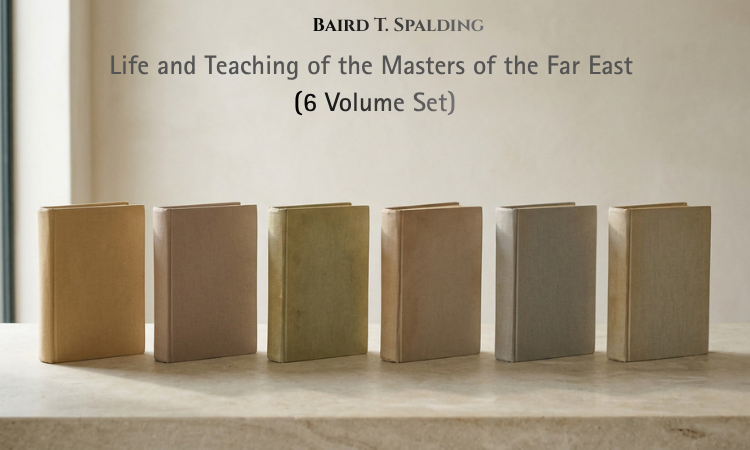
Much of this influence traces back to the work of Baird T. Spalding, whose writings introduced these teachings to a wider audience.
Part of the answer lies in how they are encountered. Readers often discover the series through recommendation rather than search.
Someone shares it. A passage resonates. The books are not consumed quickly. They are revisited.
At the same time, the series exists within a tension that has never been fully resolved.
Some approach it as a record of real events. Others view it as symbolic or allegorical.
The absence of clear historical verification has led to ongoing debate.

Why These Books Continue to Circulate Quietly
Yet the discussion itself does not explain the continued influence.
What matters is the effect.
Across different contexts, readers report shifts in perception rather than simple agreement or disagreement.
The books do not ask for belief in a traditional sense. Instead, they present ideas that challenge the way identity, reality, and possibility are understood.
This is where a deeper examination becomes necessary.
Rather than summarizing each volume, this analysis looks at the structure behind the series.
What is being presented? What remains consistent across the volumes?
And why does the material continue to affect readers despite the controversy surrounding it?
Understanding these questions reveals more than the content of the books.
It reveals how certain teachings operate beyond time, recognition, or validation.

Section 1 — What the Series Claims (Without Interpretation)
Any serious examination must begin with clarity.
This Life and Teachings of the Masters of the Far East review starts by looking at the claims of the series exactly as they are presented, without adding interpretation or dismissal.
According to Baird T. Spalding, the books are based on an expedition that took place in the late nineteenth century.
He describes traveling with a group of Western scientists through India, Nepal, and Tibet in search of individuals known as “Masters”—beings who had realized complete control over the laws governing life and matter.
Within the narrative, these Masters are not portrayed as distant figures or mythical entities.
They are described as living individuals who have attained a state of awareness that allows them to operate beyond ordinary limitations.
The accounts include demonstrations that challenge conventional understanding.
These range from healing without physical intervention to the ability to appear and disappear, move across space instantly, and sustain the body indefinitely.
The Masters are said to act without effort, guided by an understanding of universal law rather than personal will.
Importantly, these demonstrations are not presented as miracles in the traditional sense.
They are described as natural outcomes of alignment with deeper principles.
The implication is clear: what appears extraordinary is not a violation of nature, but an expression of laws not yet widely understood.
The narrative unfolds through encounters.
The Power of the Book Series
Each interaction introduces a teaching, often delivered in simple language.
The emphasis remains consistent. Human beings are not separate from the divine source of life.
What the Masters express is not unique to them, but available in principle to all.
This point is repeated across volumes in different forms.
At the same time, the series does not attempt to prove its claims through external evidence.
There are no photographs, no independent confirmations, and no verifiable records of the expedition.
This absence has led many to question whether the events occurred as described.
However, within the structure of the books, verification is not the focus.
The emphasis remains on the teaching itself.
This creates a distinctive dynamic. Readers are not guided toward belief through evidence.
They are presented with a framework and left to examine its implications directly.
Understanding this dynamic is essential before moving further.
The next step is not to evaluate whether the claims are true or false. It is to examine what remains consistent beneath them.

Section 2 — The Core Teaching Across All Volumes
Across changing locations, characters, and events, one principle remains constant. The language varies. The emphasis does not.
The series returns, again and again, to the same point: the source of life is not external to the individual. It is present within awareness itself.
This idea is explored in greater depth in our breakdown of the one teaching the Masters repeated more than any other.
This is not presented as abstraction. It is framed as a practical reality.
The Masters speak as if alignment with this fact changes how thought operates, how the body responds, and how action unfolds. Everything else in the books—demonstrations, conversations, and examples—rests on this foundation.
Clarity here simplifies the rest.
If the source is within, then seeking outward becomes secondary. If awareness is primary, then identity shifts.
The individual is no longer defined only by conditions, history, or limitation. A different reference point appears.
This also explains the consistency across volumes.
Different scenes introduce different contexts, yet the teaching does not change.
It is restated, reinforced, and demonstrated from multiple angles. That repetition is deliberate.
Core Teachings
The idea challenges deeply held assumptions, so it must be encountered more than once.
Another aspect becomes clear.
The books do not attempt to build a system. They do not introduce complex hierarchies or structured practices.
Instead, they return to direct statements about awareness, thought, and alignment.
This simplicity can be overlooked because it contrasts with expectations of depth.
However, the simplicity is structural, not superficial.
It removes dependency on accumulation. Rather than adding layers, the teaching points toward recognition.
Understanding does not require constructing something new.
It requires seeing what has been overlooked.
From this perspective, the rest of the series becomes coherent. The demonstrations are not separate from the teaching.
They are presented as consequences of alignment with it.
This leads to a more precise question.
If the core principle is so direct, why is it not immediately accepted?

Section 3 — The Pattern Behind the Teachings
Beyond individual statements, the series reveals a recognizable pattern. This pattern is not dependent on narrative details. It operates across volumes and contexts.
First, the teaching is repeated with minimal variation. This repetition is not used to persuade. It functions to stabilize attention. The same idea appears in different situations until it becomes difficult to ignore.
Second, the language remains direct. Explanations do not rely on technical vocabulary or layered terminology. Instead, statements are delivered in a way that can be understood without prior study. This keeps the focus on perception rather than interpretation.
Third, the teaching avoids institutional framing. There is no system to join, no hierarchy to navigate, and no requirement for external validation. The emphasis remains on direct recognition.
This absence of structure is significant.
Many spiritual traditions develop frameworks that organize knowledge. While useful, these frameworks can also create dependency. In contrast, the approach here keeps attention centered on awareness itself. Nothing is introduced that cannot be examined directly.
Another pattern appears in how demonstrations are used.
They are not presented as goals. They function as illustrations. The emphasis remains on the principle behind them rather than the outcome. This prevents distraction. The reader is guided toward understanding, not imitation.
Taken together, these elements create a consistent structure.
Repetition stabilizes attention. Simplicity removes unnecessary complexity. Directness keeps the focus internal. The absence of institutional framing prevents dependency.
This structure explains why the material can affect readers even when they question the narrative.
The effect does not rely on agreement. It arises from how the teaching is delivered.

Section 4 — The Controversy: Real or Symbolic?
No examination would be complete without addressing the central question that surrounds the series.
Did the events occur as described?
This Life and Teachings of the Masters of the Far East review must acknowledge the lack of verifiable evidence. There are no independent records confirming the expedition. The identities of the other participants remain unclear. Historical documentation is minimal.
These points form the basis of skepticism.
Critics argue that the narrative should be read as symbolic rather than literal. Supporters respond that the precision of the teachings suggests direct experience. Both positions have been maintained for decades.
However, focusing only on this question can limit the analysis.
The more relevant observation is how the material functions.
Readers who approach the books with doubt often report similar effects to those who approach them with openness. The ideas challenge assumptions about identity, thought, and possibility. This challenge occurs regardless of belief about the narrative.
From this perspective, the literal versus symbolic debate becomes secondary.
If the events are literal, they demonstrate what is possible. If they are symbolic, they illustrate principles in narrative form. In both cases, the structure of the teaching remains intact.
This does not resolve the controversy. It reframes it.
Instead of asking whether the story is true, the question becomes: what does the material reveal about perception and awareness?
That shift allows the analysis to move forward without requiring agreement.
Section 5 — Why the Books Still Work Today
Time often reduces the impact of ideas. Concepts tied to a specific context lose relevance as conditions change. Yet some material continues to affect readers across generations.
The series falls into that category.
One reason is its focus on perception rather than circumstance. External conditions evolve, but the structure of human experience remains consistent. Questions about identity, fear, control, and meaning do not disappear. The books address these directly.
Another reason is simplicity.
The teaching does not depend on cultural references or complex systems. It can be approached from different backgrounds without requiring translation into a specific framework. This allows it to remain accessible over time.
Repetition also contributes to its durability.
Key ideas appear frequently enough to remain present in the reader’s awareness. Even when the narrative is questioned, the teaching persists. It does not rely on a single moment of understanding. It develops through continued exposure.
There is also a practical dimension.
The ideas can be observed directly. They do not require external validation to be examined. Readers can test them against experience. This creates engagement. Instead of accepting or rejecting, individuals investigate.
Over time, this process produces subtle changes.
Perception becomes more stable. Reactions become less automatic. Awareness expands beyond immediate conditions. These shifts are gradual, but they accumulate.
This is why the books continue to circulate.
Their influence does not depend on recognition. It depends on effect.

Section 6 — What Most Readers Miss
The most visible elements of the series often draw the most attention. Demonstrations of unusual ability stand out. They are memorable. They invite curiosity.
However, focusing on these elements can obscure the underlying structure.
The demonstrations are not presented as objectives. They are used to illustrate alignment with a principle. When attention remains fixed on the outcome, the principle is overlooked.
This creates a common misunderstanding.
Readers may interpret the material as a collection of extraordinary events rather than a framework for perception. In doing so, they separate the demonstrations from the teaching that supports them.
Another point is often missed.
The series does not encourage imitation. It does not provide step-by-step methods for reproducing what is described. Instead, it returns to awareness, thought, and alignment. The emphasis remains on understanding rather than replication.
This distinction is important.
When the focus shifts from outcome to principle, the material becomes coherent. The demonstrations no longer appear as isolated events. They are understood as expressions of a consistent structure.
Recognizing this changes how the books are read.
Attention moves away from what is unusual and toward what is fundamental. The material becomes less about possibility and more about perception.

Section 7 — Should You Read Them Today?
The value of any book depends on how it is approached.
For readers seeking structured systems, detailed practices, or clear progression, the series may feel incomplete. It does not provide these elements in a conventional way. Its simplicity can appear insufficient.
For readers interested in examining perception, identity, and awareness, the material offers something different.
It does not require prior knowledge. It does not depend on belief. Also It invites observation. This makes it accessible, but not necessarily easy. The absence of structure places responsibility on the reader.
How the books are read matters.
Approaching them quickly can reduce their effect. The ideas require attention. Reading slowly allows repetition to have its intended impact. Returning to passages reveals patterns that may not be visible initially.
The question is not whether the books should be read.
It is how they are engaged.
When approached as a source of ideas, they remain interesting. When approached as a framework for examining awareness, they become more significant.

Conclusion — Messenger and Message
The identity of the author remains uncertain. The details of the narrative remain debated. These elements have not been resolved.
What has remained consistent is the teaching.
Over time, attention shifts away from the messenger and toward the message.
The books continue to circulate not because their origin has been confirmed, but because their structure continues to affect readers. This same pattern can be observed across other spiritual books that changed human consciousness over time.
This suggests a distinction.
A message can persist independently of its source. When this occurs, its value is no longer tied to verification. It is tied to effect.
The series demonstrates this clearly.
Whether the events are literal or symbolic, the teaching operates in the same way. It challenges assumptions. And It redirects attention. It simplifies what is often complicated.
This is why it endures.
In the end, the question of authorship becomes less central. What remains is the possibility of seeing differently.
That possibility does not depend on agreement.
It depends on recognition.
Frequently Asked Questions About the Masters of the Far East
Are the Masters of the Far East books based on real events?
The historical accuracy of the expedition is debated. However, many readers focus on the teachings themselves rather than verifying the narrative.
Who was Baird T. Spalding?
He is the author of the series, though much of his personal history remains unclear and widely discussed.
What is the main teaching of the series?
The books consistently emphasize that the source of life and consciousness exists within the individual.
Why are the books still popular today?
They address timeless aspects of perception, identity, and awareness that remain relevant regardless of era.
Are the teachings religious?
No. They appear across traditions but are presented as universal principles rather than doctrine.
Should the books be read literally or symbolically?
Readers approach them in different ways. The impact often depends more on engagement with the ideas than on interpretation of the narrative.