Inner Doorway
Across cultures, spiritual traditions have used symbols to communicate ideas that are difficult to express with words alone.
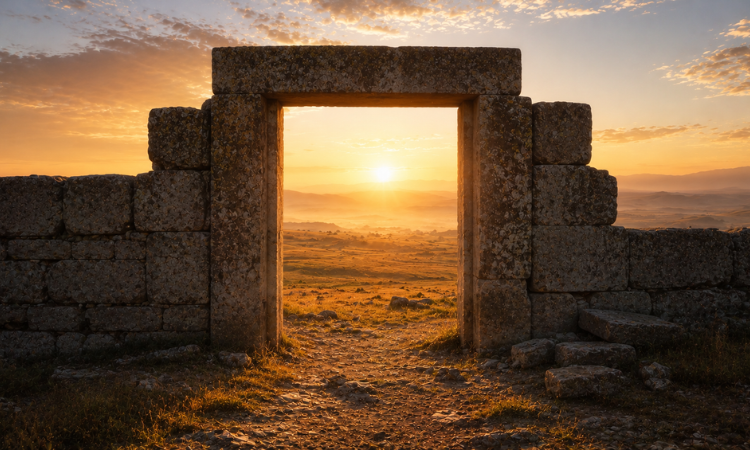
Among the most enduring of these symbols is the doorway.
A doorway represents transition. It marks the movement from one space into another. Spiritually, it often points toward a shift in awareness rather than a change in location.
Many people spend years searching for meaning, fulfillment, or awakening in the external world. They look for answers in teachers, books, philosophies, and experiences.
While these can provide valuable guidance, many spiritual traditions eventually direct attention toward something closer.
They point toward the **inner doorway**.
Unlike a physical entrance, this doorway cannot be found on a map. It exists within consciousness itself.
The image of a doorway appears repeatedly throughout spiritual literature because it symbolizes a profound realization: the journey many people seek outwardly often begins inwardly.
Understanding this symbol can transform the way we view personal growth, awareness, and spiritual awakening.
What Does the Inner Doorway Symbolize?
At its core, the **inner doorway** symbolizes access to a deeper level of awareness.
Most people experience life through habitual patterns of thought, emotional reactions, and conditioned beliefs. These patterns shape perception so completely that they often go unquestioned.
Over time, the mind creates a framework through which reality is interpreted.
The doorway represents an opportunity to move beyond that framework.
Crossing such a threshold does not mean abandoning ordinary life. Instead, it means seeing life from a different perspective.
The individual begins recognizing that awareness itself exists prior to many of the mental stories that create confusion and limitation.
This symbolism appears in countless traditions. Ancient mystics, contemplatives, and spiritual teachers often described awakening as entering a new state of understanding.
The doorway serves as a visual representation of this transition.
Rather than discovering something entirely new, the individual begins recognizing what was already present but previously overlooked.
Why Spiritual Awakening Begins Within
One of the most common assumptions in spiritual seeking is that transformation comes from acquiring something external.
People often believe they need a special teacher, a secret technique, or a dramatic experience before meaningful change can occur.
While external guidance can be helpful, lasting transformation usually begins through a change in perception.
This is where the **inner doorway** becomes important.
Spiritual awakening is frequently described as a movement from outward dependency toward inward recognition. Instead of constantly searching for answers outside themselves, individuals begin observing their own awareness more carefully.
Many teachings associated with the Masters of the Far East emphasize this principle. The focus repeatedly returns to direct experience rather than blind belief.
Truth is not presented as something imposed from outside. It is discovered through observation, awareness, and recognition.
This perspective changes the nature of the spiritual journey. The search becomes less about accumulation and more about understanding.
As awareness deepens, many of the assumptions that once seemed permanent begin to lose their hold.

The Wall Between Awareness and Recognition
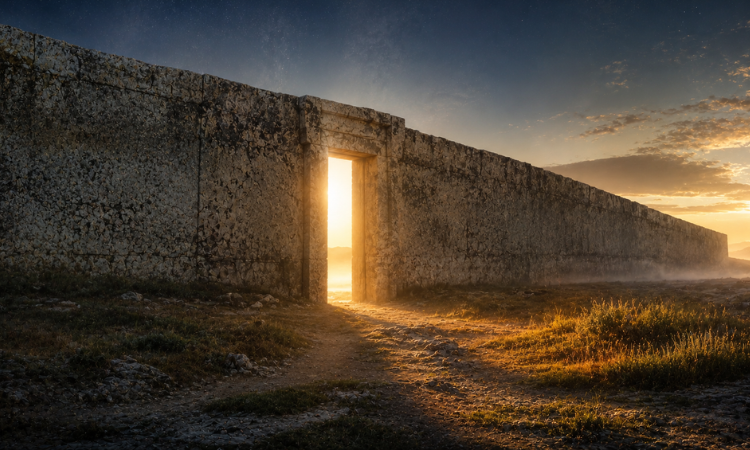
The symbol of a doorway often appears alongside another important image: a wall.
Spiritually speaking, the wall represents separation.
People frequently feel separated from peace, wisdom, fulfillment, or purpose. This sense of distance creates a belief that something essential is missing.
As a result, life becomes a continuous search for what appears to be beyond reach.
However, many spiritual traditions challenge this assumption.
The obstacle is not always the absence of truth. Often, the obstacle is the belief that truth exists somewhere else.
Conditioning, fear, self-doubt, and habitual thinking can create a psychological wall that appears solid and permanent. Yet a doorway remains present within that wall.
The possibility of a different perspective is always available.
This is why awareness plays such a central role in spiritual growth.
The wall weakens when observation becomes stronger. The individual begins noticing thoughts rather than becoming controlled by them. Old assumptions lose some of their authority.
What once seemed fixed begins to appear more flexible.
The doorway was always there. Awareness simply makes it visible.
How the Inner Doorway Appears in Spiritual Traditions
Although traditions use different language, the symbolism remains remarkably consistent.
In Christian mysticism, individuals are encouraged to seek the kingdom within. In Eastern traditions, awareness is often directed toward the true nature of consciousness.
Contemplative paths across the world emphasize silence, observation, and inner recognition.
These teachings differ in form, yet they point toward a similar insight.
The **inner doorway** represents a shift from identification with surface experience toward a deeper understanding of awareness itself.
This does not require withdrawal from everyday life. Many spiritual teachers emphasized living fully within the world while maintaining a deeper level of perception.
The doorway is therefore not an escape from reality.
It is an invitation to experience reality more clearly.
Throughout history, those who crossed this symbolic threshold often described greater clarity, reduced fear, and a stronger sense of connection with life.
The external world remained the same, but their relationship to it changed.
That shift is the essence of spiritual awakening.

What Prevents People From Crossing the Threshold?
If the doorway is always available, why do so many people struggle to find it?
One reason is familiarity.
Human beings naturally gravitate toward what feels known, even when familiar patterns create dissatisfaction.
Change introduces uncertainty, and uncertainty can feel uncomfortable.
Fear also plays a role.
Crossing a threshold often requires questioning long-held assumptions. It may involve releasing beliefs that once provided security.
Although such changes can be liberating, they also require courage.
Another obstacle is distraction.
Modern life constantly competes for attention. Continuous stimulation leaves little room for reflection or observation.
Without moments of stillness, deeper awareness can remain hidden beneath mental noise.
This is one reason many traditions emphasize silence and contemplation. These practices create space for recognition.
They allow attention to settle long enough for deeper insights to emerge.
The doorway does not force itself upon anyone.
It becomes visible when awareness becomes quiet enough to notice it.
Recognizing the Inner Doorway in Everyday Life
The **inner doorway** is not limited to spiritual retreats, sacred texts, or extraordinary experiences.
It often appears in ordinary moments.
A period of reflection may reveal an assumption that no longer serves us. A moment of stillness may expose a deeper sense of clarity.
A challenging situation may create an opportunity to respond with awareness rather than automatic reaction.
These seemingly simple experiences can become thresholds.
Each moment of conscious observation creates the possibility of seeing differently. Over time, these small recognitions accumulate.
Awareness becomes more stable. Perception becomes less reactive.
Gradually, the individual begins living from a deeper center.
The doorway is no longer viewed as a distant destination. It becomes an ongoing process of awakening within everyday life.
This realization transforms spiritual growth from a future goal into a present experience.

Inner Doorway Conclusion
The symbol of the **inner doorway** continues to appear throughout spiritual traditions because it captures a timeless truth.
Many people spend years searching externally for what can only be recognized internally. Teachers, books, and experiences may point the way, but the actual crossing must occur within awareness itself.
The doorway represents more than transformation. It represents recognition.
Behind it lies no secret world, hidden power, or exclusive knowledge. Instead, it reveals a deeper relationship with life, consciousness, and self-understanding.
Perhaps the most remarkable aspect of this symbol is its simplicity.
The doorway is already open.
The invitation has always been there.
The question is whether we are willing to step through it.

❓ FAQ
What does the inner doorway symbolize?
The inner doorway represents the shift from external searching to direct awareness and self-recognition.
Why is the doorway a common spiritual symbol?
It reflects the transition between limited perception and expanded understanding.
What prevents people from crossing the doorway?
Fear, attachment to familiar patterns, and the belief that fulfillment exists outside oneself.
Is the inner doorway connected to spiritual awakening?
Yes. Many traditions describe awakening as a movement from outward seeking toward inner recognition.
Can anyone access the inner doorway?
According to many spiritual teachings, the doorway is available to everyone because it exists within awareness itself.