
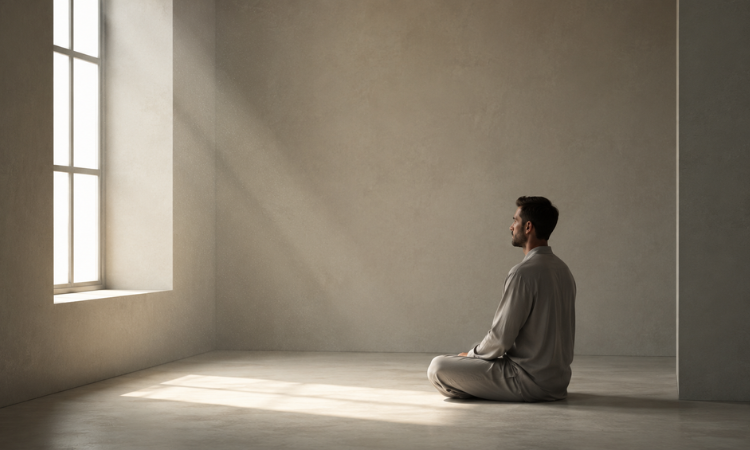
Silence as Power — Why Silence Feels Difficult Today
Modern life rarely becomes quiet.
Even in moments of physical stillness, the mind continues moving through unfinished conversations, constant stimulation, internal reactions, and endless streams of information. Attention is repeatedly pulled outward until silence itself begins to feel unfamiliar.
This is one reason many people struggle when external noise disappears.
Without distraction, hidden tension becomes visible. Restlessness surfaces. Thoughts become louder. What seemed manageable during activity suddenly feels difficult in stillness. Silence exposes what constant movement often conceals.
Yet the Masters approached silence differently.
They did not treat it as emptiness, withdrawal, or passivity. Instead, silence was understood as a condition in which perception becomes clear. Beneath reduced mental noise, awareness sharpens. Reactions slow. Attention stabilizes.
Much of this noise keeps attention directed outward, which is why the one teaching the Masters repeated more than any other emphasized returning inward.
This perspective changes the meaning of silence entirely.
Instead of absence, silence becomes presence without interference. Instead of suppression, it becomes observation without constant reaction. The emphasis is not on escaping the world, but on seeing it without distortion.
In this sense, silence as power has little to do with force or control. The power described by the Masters emerges from clarity. A quiet mind reacts less impulsively, perceives more accurately, and remains less influenced by external conditions.
That is why silence appears repeatedly throughout many spiritual traditions.
Not because silence itself is magical, but because awareness becomes easier to recognize when unnecessary noise diminishes.
Understanding this distinction is essential before going further.
The Masters were not encouraging isolation from life. They were pointing toward a different relationship with thought, attention, and perception.

Section 1 — Why the Masters Valued Silence
The Masters rarely emphasized excessive speech.
Within many of the accounts surrounding their teachings, communication appears deliberate, restrained, and precise. Words are used carefully. Long explanations are uncommon. Attention is placed more heavily on perception than verbal instruction.
This restraint was not accidental.
The Masters understood that constant speech can weaken observation. When attention continuously moves outward through reaction and expression, awareness becomes fragmented. Silence interrupts this fragmentation and allows attention to gather again.
In the writings of Baird T. Spalding, silence is repeatedly associated with clarity, presence, and direct perception.
This connection appears across multiple teachings.
Silence creates space between thought and reaction. Instead of responding automatically, the individual begins to observe more carefully. Emotional impulses become easier to recognize before they fully take control. Thought slows enough for deeper patterns to emerge.
This explains why silence was often treated as discipline rather than comfort.
Silence As Discipline
The purpose was not simply to remain quiet externally. External silence without internal stillness changes very little. The deeper aim involved reducing unnecessary mental movement so awareness could become more stable.
Another important distinction appears here.
The Masters did not present silence as weakness or withdrawal. Modern culture frequently associates power with visibility, persuasion, and constant expression. The teachings move in the opposite direction. They suggest that individuals who constantly need to react are often being controlled by external conditions without realizing it.
Silence changes this relationship.
A quiet mind becomes less impulsive. External situations still exist, but they no longer dictate every internal response. This creates a different form of stability—one based less on control and more on clarity.
The effect is subtle but significant.
When unnecessary internal noise decreases, perception sharpens naturally. Small details become easier to notice. Emotional tension becomes more visible. Decisions emerge with less confusion.
Over time, silence stops feeling empty.
It begins to feel structured, alert, and deeply present.

Section 2 — Silence Changes Perception
Most people assume perception depends mainly on what they see. The Masters approached perception differently. They understood that perception is shaped not only by external conditions, but also by the state of the observer.
This changes everything.
A mind filled with constant reaction rarely sees clearly. Thoughts overlap continuously. Attention jumps from one stimulus to another. Emotional tension filters experience before awareness has time to observe directly.
Silence interrupts this process.
As internal noise decreases, perception begins to reorganize naturally. Details that once passed unnoticed become visible. Emotional reactions slow enough to be examined instead of immediately acted upon. Awareness becomes less crowded.
This is why silence was treated as practical rather than symbolic.
The effect is observable. A quiet mind processes experience differently from a restless one. Situations that previously triggered impulsive reactions begin to appear with greater clarity. Interpretation becomes less distorted by fear, projection, or internal pressure.
Importantly, this shift does not require isolation from life.
The Masters did not suggest abandoning responsibility or activity. Instead, they emphasized carrying inner stillness into ordinary experience. Silence was not confined to remote places. It became a way of relating to thought itself.
This distinction matters.
Silence as a Relation to Thought
External quiet can help initially, but silence as awareness operates independently of environment. A person may sit alone while remaining mentally chaotic. Another may move through activity while maintaining unusual clarity. The difference lies in internal movement, not surroundings.
The relationship between silence and perception also explains why many spiritual traditions emphasize observation.
Observation weakens automatic identification with thought. Instead of becoming every reaction, the individual begins to notice reactions appearing within awareness. This creates distance—not emotional suppression, but perspective.
Over time, perception becomes less reactive and more precise.
Situations are no longer experienced entirely through mental noise. Awareness starts to recognize what is present before interpretation takes over.
That is one reason silence was considered powerful.
It changes not only what is noticed, but how reality itself is experienced.
Section 3 — Why Modern Life Fears Silence
Modern culture depends heavily on stimulation.
Information moves constantly. Notifications interrupt attention throughout the day. Entertainment fills empty space almost immediately. Even brief moments of stillness are often replaced by scrolling, background noise, or mental distraction.
This environment conditions the mind toward continuous engagement.
As a result, silence begins to feel uncomfortable. Many people discover this quickly when external stimulation disappears. Restlessness surfaces almost immediately. Thoughts accelerate. Emotional tension that remained hidden during activity becomes more visible.
The discomfort is understandable.
Silence removes distraction, and distraction often functions as avoidance. Constant stimulation keeps attention moving fast enough to prevent deeper observation. Without that movement, unresolved patterns become easier to notice.
This helps explain why many people avoid silence without realizing it.
A quiet environment can expose how fragmented attention has become. Thoughts repeat automatically. Emotional reactions continue long after external events end. The mind searches constantly for the next point of engagement.
The Masters recognized this pattern long before modern technology intensified it.
Their teachings repeatedly point toward reducing unnecessary internal movement rather than increasing stimulation. This was not presented as rejection of life. It was a way of preventing awareness from becoming dominated by constant reaction.
Continuous stimulation weakens the ability to observe clearly. This is also why many people rediscover awareness through a deeper spiritual connection with nature.
The Power of Natural Environment
Natural environments slow perception differently.
The rhythm of nature does not demand constant reaction. Attention begins to settle. Internal pace changes gradually. This is one reason silence often feels more accessible in natural surroundings than in highly stimulated environments.
Another important point emerges here.
Modern life frequently rewards speed over clarity. Immediate response is encouraged. Silence interrupts this pattern by delaying reaction long enough for observation to occur first.
That interruption is powerful.
Without it, awareness remains trapped inside automatic movement. With it, perception begins to regain stability.
This is why silence can feel threatening initially.
It reveals how much internal noise has been normalized.

Section 4 — Silence as Inner Authority
Many people search for authority outside themselves.
They look for certainty through opinions, systems, institutions, or constant external validation. While guidance can be useful, dependence on external direction often weakens direct perception. Attention becomes conditioned to react rather than observe.
The Masters approached authority differently.
They emphasized clarity arising from awareness itself. This did not mean rejecting teachers or knowledge. It meant developing the ability to perceive without becoming completely controlled by external influence.
Silence plays a central role in this process.
When mental noise decreases, internal reactions become easier to examine objectively. Emotional impulses no longer dominate every decision immediately. Space appears between stimulus and response. Within that space, discernment strengthens.
This creates a quieter form of authority.
It is not based on dominance, visibility, or persuasion. Instead, it emerges from reduced internal conflict. The individual becomes less dependent on constant affirmation because perception itself becomes more stable.
The Secret Process
This stability changes behavior naturally.
Speech becomes more deliberate. Reactions become less impulsive. Decisions arise with greater coherence because they are not formed entirely inside emotional turbulence.
The Masters often demonstrated this through presence rather than argument.
Accounts repeatedly describe calmness under pressure, careful speech, and unusual composure during difficult situations. Their authority appeared connected less to force and more to clarity. Silence supported that clarity by preventing awareness from becoming scattered.
Another important shift occurs here.
Inner stillness weakens the need to prove oneself continuously. Much unnecessary speech comes from insecurity, fear, or the desire for validation. Silence exposes these motivations gradually. Once visible, they lose some of their control.
This does not produce passivity.
It produces precision.
The individual begins responding intentionally rather than automatically. Attention becomes less fragmented by external pressure. Awareness remains present even during difficulty.
Over time, silence stops feeling restrictive.
It becomes a source of stability that strengthens perception from within.

Section 5 — The Psychological Effect of Silence
Silence affects more than mood. It changes the structure of attention itself.
When constant stimulation decreases, the nervous system gradually shifts out of continuous reactivity. Thoughts still appear, but they no longer move with the same intensity. Emotional patterns become easier to observe before they fully take control.
This shift is psychological as much as spiritual.
Many people live in a near-constant state of internal acceleration. Even during rest, the mind continues processing unfinished concerns, imagined scenarios, and repetitive reactions. Over time, this creates exhaustion that feels normal simply because it has become familiar.
Silence interrupts that cycle.
At first, the interruption can feel uncomfortable. Without distraction, unresolved tension becomes visible. Hidden anxiety, impatience, or emotional fatigue rise into awareness more clearly. This is one reason silence initially feels difficult for many individuals.
The Masters understood this process.
Silence was not treated as escape from the mind, but as a way of seeing the mind more accurately. Observation gradually weakens unconscious repetition. Thoughts lose some of their automatic authority once they are clearly seen.
Another effect appears slowly.
Internal pace begins to change. Reactions that once occurred immediately start to slow down. Awareness recognizes emotional movement earlier, before it fully shapes behavior. This creates a subtle but important form of psychological freedom.
Effect of Silence
Attention also becomes less fragmented.
Modern stimulation continuously divides focus across multiple directions. Silence reverses this fragmentation by allowing awareness to settle into a more unified state. Concentration strengthens naturally because less energy is being scattered through constant reaction.
The emotional effects are equally significant.
Silence often reduces the need for immediate resolution. Instead of forcing answers or reacting impulsively, the mind becomes more capable of remaining present with uncertainty. This increases psychological stability because awareness no longer depends entirely on control.
Over time, silence begins to feel restorative rather than empty.
Mental pressure decreases. Observation sharpens. Emotional reactions lose intensity more quickly. The individual experiences greater coherence between thought, perception, and action.
This is why silence was never viewed by the Masters as inactivity.
It was understood as a condition that reorganizes awareness from within.

Section 6 — How to Practice Silence Correctly
Silence is often misunderstood as the complete absence of thought. The Masters did not approach it that way. Trying to force the mind into total stillness usually creates more internal tension rather than less.
The deeper practice begins with observation.
Instead of fighting thought, attention becomes quieter through reduced identification with it. Thoughts continue appearing, but they are no longer followed automatically. Awareness learns to remain present without reacting to every mental movement.
This changes the entire process.
Silence becomes less about control and more about relationship. The goal is not suppression. It is clarity.
A practical beginning is simplicity.
Brief periods without external stimulation allow attention to settle gradually. No music. And no phone. No constant input. Even a few minutes of uninterrupted quiet begins revealing how active the mind normally is.
Consistency matters more than duration.
Long periods of forced silence often create frustration. Short, regular moments of observation are usually more effective. Over time, awareness stabilizes naturally without excessive effort.
The environment also influences the process.
Nature Secret Influence on Man
Natural settings often support silence more easily because they reduce overstimulation. This does not mean silence depends entirely on location, but quieter environments can help awareness reorganize initially.
Another important principle is restraint in speech.
The Masters frequently demonstrated careful communication. Silence was not only internal. It also appeared in how words were used. Speaking less impulsively reduces unnecessary mental movement and increases clarity before expression.
This does not require withdrawal from life.
The aim is not isolation or emotional detachment. Silence becomes most valuable when it remains present during ordinary activity. Awareness learns to stay steady even while engaging with responsibilities, conversation, and decision-making.
Over time, the practice becomes less artificial.
Stillness begins appearing naturally between thoughts. Reactions lose intensity more quickly. Attention remains more stable under pressure. Silence stops feeling like an exercise and starts becoming a condition of perception itself.
This is why the Masters treated silence as power.
Not because it removes life, but because it allows life to be experienced with greater clarity.

Silence as Power — Silence Is Not Emptiness, but Clarity
The Masters did not value silence because they feared the world. They valued it because silence changes the way the world is perceived.
Without constant internal noise, awareness becomes more precise. Reactions slow. Observation deepens. Attention returns to the present instead of remaining trapped inside continuous mental movement.
This is where the real power of silence appears.
Not in withdrawal. Not in passivity. But in clarity without interference.
Modern life conditions the mind toward constant stimulation. As a result, many people experience silence as discomfort rather than stability. Yet beneath that discomfort lies something important. Silence reveals what distraction often hides.
The teachings of the Masters repeatedly point toward this recognition.
A quiet mind is not empty. It is attentive. It perceives more clearly because less energy is consumed by unnecessary reaction. From this clarity, decisions become more coherent and awareness less fragmented.
Silence therefore becomes practical, not symbolic.
It changes how thought is experienced. It changes how emotion moves through awareness. Most importantly, it changes the relationship between the individual and constant external influence.
Over time, silence stops feeling like absence.
It begins to feel like presence without distortion.
❓ Frequently Asked Questions About Silence and Spiritual Awareness
Why did the Masters value silence so deeply?
The Masters viewed silence as a condition that strengthens awareness, reduces internal distraction, and sharpens perception.
Is silence only about not speaking?
No. External quietness alone is not enough. The deeper form of silence involves reducing unnecessary internal mental movement.
Why does silence feel uncomfortable at first?
Silence removes distraction, which often reveals hidden tension, emotional patterns, and constant mental activity.
Can silence improve clarity and decision-making?
Yes. A quieter mind reacts less impulsively and observes situations more carefully before responding.
Is silence connected to spiritual growth?
Many spiritual traditions associate silence with deeper awareness because it helps perception become less reactive and more present.
How can someone begin practicing silence?
Start with short periods without stimulation, observe thoughts without fighting them, and gradually develop steadier attention.