
Higher Perspective
There comes a moment on every authentic spiritual journey when nothing around us appears to have changed, yet everything begins to look different.
The same relationships remain. The same responsibilities continue. The same world unfolds before our eyes. Yet our experience of it shifts in a profound way because perception itself has expanded.
This transformation is what many spiritual traditions describe as higher perspective.
Despite its name, higher perspective has little to do with seeing oneself above others. It is not about superiority, status, or possessing secret knowledge. Instead, it refers to the gradual ability to view life from a broader, calmer, and more conscious point of awareness.
Throughout history, mystics, philosophers, and the Masters have returned repeatedly to this principle. They understood that lasting transformation rarely begins by changing external circumstances. Instead, it begins by changing the observer.
When perception matures, reality reveals dimensions that previously remained hidden beneath fear, habit, and emotional reaction.
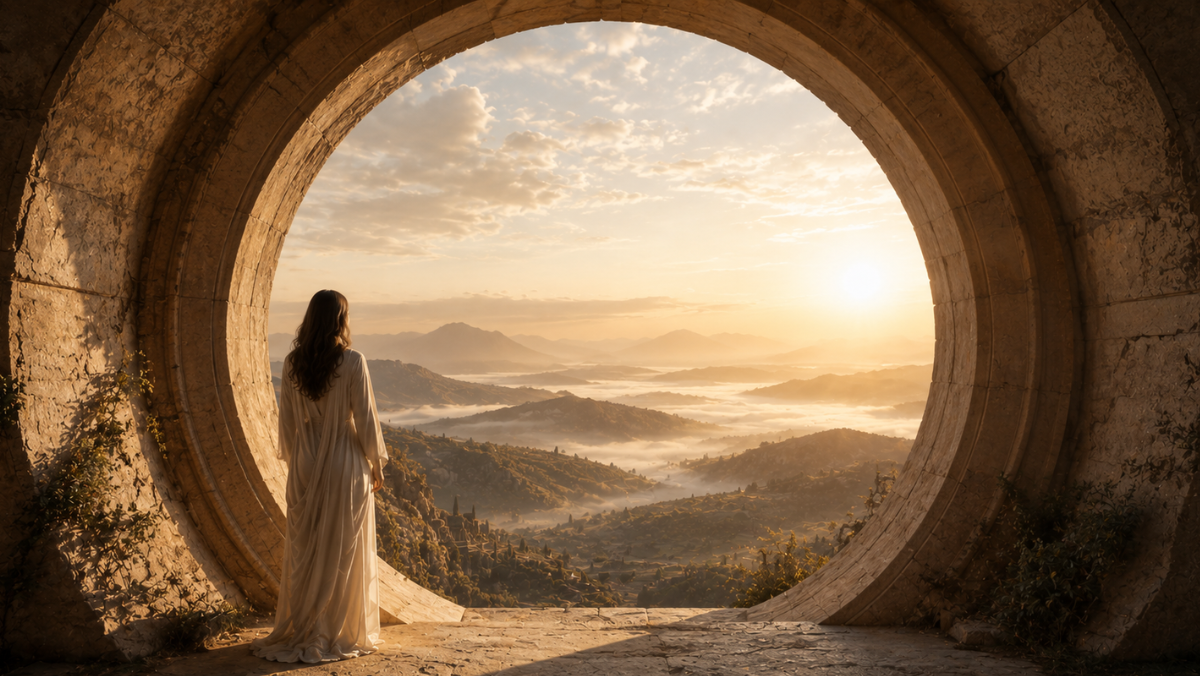
The image accompanying this article captures that timeless idea.
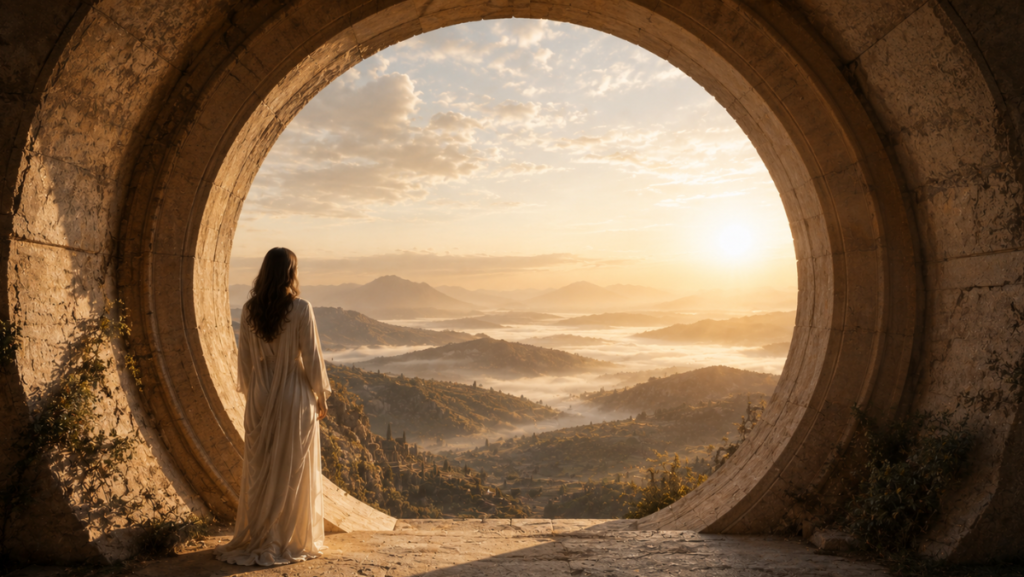
A solitary figure stands before an immense circular opening overlooking a landscape bathed in the light of a new day. She does not rush forward or look behind. She simply observes.
This quiet posture illustrates one of the deepest truths found across spiritual traditions.
Before life changes, the way we see life changes.
Understanding higher perspective helps explain why wisdom often appears so calm, why genuine spiritual maturity rarely seeks attention, and why the greatest discoveries are frequently made through observation rather than action.
What Is Higher Perspective?
Many people associate a higher perspective with optimism or positive thinking.
Although these qualities can be valuable, they are not the same thing.
Positive thinking often attempts to replace negative thoughts with encouraging ones. A higher perspective goes much deeper. It changes the framework through which experience is interpreted.
Rather than asking whether an event is good or bad, awareness begins asking what the experience is revealing.
This subtle shift transforms the entire spiritual journey.
Imagine two people encountering the same difficulty.
One immediately sees failure.
The other sees an opportunity to understand, adapt, and grow.
The external event is identical.
Why Perception Influences Experience
And the perspective is entirely different.
This illustrates why perception influences experience so profoundly.
Every thought, emotion, and decision passes through the lens of interpretation before becoming part of our reality. When that lens remains clouded by fear, attachment, or habitual thinking, even positive circumstances can generate anxiety.
Conversely, a clear perspective often discovers possibility within apparent setbacks.
The Masters consistently emphasized this principle.
They rarely encouraged people to escape the world.
Instead, they encouraged them to see it differently.
From this viewpoint, spiritual growth becomes less about acquiring extraordinary experiences and more about refining ordinary perception.
Life does not necessarily become easier.
It becomes clearer.
This distinction explains why genuine wisdom often appears remarkably practical.
Rather than removing us from reality, higher perspective allows us to engage with reality more intelligently, compassionately, and consciously.
Why Perception Shapes Every Spiritual Journey
Every human being experiences the world through perception.
We do not respond directly to reality itself.
We respond to our interpretation of reality.
This simple observation has enormous implications.
Two individuals may witness exactly the same event while drawing entirely different conclusions.
One perceives loss.
Another recognizes opportunity.
One experiences rejection.
Another discovers redirection.
Neither response is determined solely by external circumstances.
Both arise from perception.
For this reason, nearly every authentic spiritual tradition places extraordinary importance on awareness.
The Masters understood that changing the world without changing perception often produces temporary improvement but lasting dissatisfaction. Old patterns simply reappear in new situations because the observer has remained the same.

The Source of Transformation
Real transformation begins elsewhere.
It begins when awareness becomes capable of observing itself.
Instead of reacting automatically, the individual begins noticing the thoughts, assumptions, and emotional patterns shaping each experience.
This moment marks an important turning point.
Life stops happening only to us.
It begins teaching us.
Challenges become invitations to understand ourselves more deeply.
Success becomes an opportunity for gratitude rather than attachment.
Relationships become mirrors revealing aspects of our own awareness.
Gradually, every experience acquires a second dimension.
Events still occur.
Difficulties still arise.
However, beneath every circumstance lies another question.
What is this experience asking me to see?
That question represents one of the first signs that perspective is expanding.
As it develops, the need to control every external condition gradually weakens.
Instead, greater attention is given to cultivating clarity within.
This shift explains why many of history’s wisest individuals remained remarkably composed during uncertainty.
Their confidence did not depend entirely upon circumstances.
It rested upon the quality of their perception.
The Difference Between Seeing and Looking
Human beings spend their entire lives looking.
We look at people.
Also we look at situations.
We look at opportunities, challenges, successes, and failures.
Yet surprisingly few people truly see.
Although the words are often used interchangeably, they describe two very different ways of engaging with reality.
Looking is automatic.
Seeing is conscious.
Looking depends primarily on the eyes. It gathers information about the external world, allowing us to recognize objects, navigate our surroundings, and respond to immediate circumstances. This ability is essential for daily life, but by itself it reveals only what appears on the surface.
Seeing reaches much deeper.
It involves perception that extends beyond appearances. Rather than noticing only what is visible, it begins recognizing patterns, relationships, intentions, and meanings that cannot always be observed directly.
This distinction explains why two people can witness the same conversation yet leave with entirely different understandings.
One hears only the words.
The other notices the emotions behind them.
One focuses on the disagreement.
The other recognizes the fear creating it.
The event remains identical.
Awareness has changed.
Throughout history, spiritual traditions have consistently encouraged this deeper form of perception.
The Masters rarely asked their students merely to observe external events. Instead, they invited them to examine the observer.

Examining The Observer
Who is reacting?
Why does this situation create resistance?
What belief is shaping this interpretation?
Questions like these gradually transform perception itself.
Instead of becoming absorbed by every circumstance, awareness begins observing both the event and the internal response occurring simultaneously.
This marks an extraordinary shift.
Life no longer appears as a series of isolated experiences.
It becomes a continuous opportunity to understand consciousness more deeply.
The ability to see clearly also changes our relationship with other people.
Instead of reducing individuals to their behavior, we begin recognizing the fears, hopes, conditioning, and experiences influencing their actions. Compassion grows naturally because perception has expanded beyond appearances.
This does not mean excusing harmful behavior.
Rather, it means responding with greater understanding while maintaining healthy discernment.
Ironically, genuine clarity often makes life simpler.
Many conflicts arise because people react to assumptions rather than reality itself. Seeing interrupts this cycle by encouraging observation before judgment. Related Reading: Stillness sharpens perception. Explore why silence has always been considered one of the greatest spiritual disciplines in Why the Masters Considered Silence a Form of Power.
The individual becomes less interested in proving a point and more interested in understanding what is actually happening.
Over time, this way of seeing becomes one of the defining characteristics of wisdom.
Not because it produces extraordinary knowledge.
But because it reveals ordinary life more completely.

What Prevents a Higher Perspective?
If a higher perspective is available to everyone, why does it remain so difficult to sustain?
The answer lies not in the absence of awareness but in the presence of obstacles that continually narrow perception.
These obstacles rarely appear dramatic.
Most develop quietly through daily habits of thought and emotion.
One of the most influential is fear.
Fear naturally directs attention toward immediate survival. It narrows perception, making long-term understanding difficult. When the mind becomes consumed by uncertainty, it often overlooks possibilities that would otherwise appear obvious.
A second obstacle is emotional identification.
Every person experiences anger, disappointment, excitement, and joy. Problems arise when these emotions become the only lens through which reality is interpreted. Related Reading: Many of these inner obstacles originate at the threshold of awareness itself. Continue with The Inner Doorway: A Timeless Symbol of Spiritual Awakening.
For example, a difficult conversation may seem like a personal attack when viewed through insecurity. The very same conversation may later reveal itself as constructive feedback once emotional intensity has settled.
The circumstance has not changed.
Perspective has.
Attachment also limits perception.
People naturally become attached to opinions, beliefs, identities, and expectations. These attachments provide a sense of certainty, yet they can quietly prevent new understanding from emerging.
When awareness becomes attached to being right, curiosity begins to disappear.
Power Of Discernment
Discernment gives way to defensiveness.
This explains why some of the wisest individuals remain remarkably open-minded despite possessing extensive knowledge.
Their confidence rests in observation rather than rigid certainty.
Another significant obstacle is constant distraction.
Modern life rarely allows the mind to remain still. Continuous notifications, endless streams of information, and constant stimulation leave little room for deep reflection. As attention becomes fragmented, perception loses depth.
The Masters understood something that modern neuroscience increasingly confirms.
Attention shapes experience.
Whatever consistently receives our attention gradually influences the way we interpret reality.
For this reason, many contemplative traditions emphasize silence, stillness, and intentional observation.
These practices do not remove us from life.
They remove the noise that prevents us from seeing life clearly.
Finally, perhaps the greatest obstacle is the illusion that perspective has already reached its highest point.
Spiritual growth slows whenever individuals believe there is nothing more to learn.
Humility protects against this danger.
It recognizes that every experience, every relationship, and every challenge may reveal another layer of understanding.
The higher the perspective becomes, the greater the appreciation for how much remains to be discovered.
Paradoxically, genuine wisdom rarely claims complete certainty.
Instead, it develops increasing confidence alongside increasing openness.
That balance is one of the clearest signs that awareness is continuing to mature.

How the Masters Cultivated a Higher Perspective
One question naturally arises after understanding the importance of perspective.
How did the Masters develop it?
Contrary to popular imagination, they did not rely upon extraordinary techniques reserved for a select few. Their teachings consistently point toward disciplines that remain available to anyone willing to practice them with sincerity and patience.
The first was observation.
Before attempting to change the world, they learned to observe it carefully. More importantly, they observed themselves. Thoughts, emotions, expectations, and reactions became objects of awareness rather than unquestioned truths.
This simple practice transformed perception.
Instead of being carried unconsciously by every passing emotion, they gradually developed the ability to witness inner movement without becoming completely identified with it.
Silence also played a central role.
Rather than filling every moment with conversation or activity, the Masters understood the value of allowing awareness to settle. In stillness, unnecessary mental noise gradually diminished, making subtler patterns easier to recognize.
The Key Cultivation
This explains why why the Masters considered silence a form of power. Silence was never an escape from life. It became the environment in which perception matured.
Another defining characteristic was simplicity.
The Masters rarely complicated their teachings with unnecessary theories. They consistently returned to universal principles that could be verified through direct experience.
This simplicity protected them from becoming trapped by intellectual complexity.
Instead of collecting endless explanations, they refined their ability to observe life itself.
Patience completed the process.
A higher perspective cannot be forced.
Just as the sunrise appears gradually, expanded awareness unfolds over time. Every experience becomes another opportunity to see more clearly.
The Masters therefore measured progress differently.
Rather than asking, “How much have I learned?”
They quietly asked,
“How clearly am I seeing today?”
That question remains just as relevant now as it was centuries ago.
Seven Daily Practices That Expand Perspective
Although higher perspective develops gradually, everyday habits strongly influence its growth.
Small, consistent practices often produce greater transformation than occasional dramatic experiences.
The first practice is creating space before reacting.
Whenever something unexpected occurs, pause for a moment before responding. This brief interruption weakens automatic reactions and allows awareness to participate in the decision.
The second practice is questioning assumptions.
Much of what creates suffering begins with interpretations rather than facts. Simply asking, “Is there another way to understand this situation?” often reveals possibilities that emotional reactions initially conceal.
The third practice is spending regular time in nature.
Natural environments operate according to rhythms that encourage observation rather than urgency. A quiet walk through a forest, along a coastline, or across open countryside gently broadens perception without requiring effort.
The fourth practice is reducing unnecessary mental noise.
Modern life encourages constant stimulation. Deliberately creating moments without music, social media, or endless information allows attention to recover its natural depth.
The fifth practice is listening more than speaking.
People often hear only enough to prepare their next response. Genuine listening slows the mind and develops the ability to perceive what is being communicated beneath the words.
The sixth practice is reflecting before the day ends.
Rather than judging the day as good or bad, ask simple questions.
What did today teach me?
Where did I react automatically?
What helped me remain clear?
These reflections gradually strengthen awareness without creating self-criticism.
Finally, practice gratitude without denying reality.
Gratitude does not ignore difficulty. Instead, it widens perception enough to recognize that every experience contains opportunities for learning, compassion, and growth.
Over time, these seemingly modest habits reshape the way life is experienced.
Perspective expands not through dramatic breakthroughs, but through countless moments of conscious attention.

Living From a Higher Perspective
The greatest test of any spiritual principle is whether it transforms ordinary life.
Higher perspective is no exception.
Its value appears most clearly in everyday situations rather than extraordinary moments.
Relationships become one example.
Instead of reacting immediately during disagreement, awareness begins asking what lies beneath another person’s behavior. Compassion increases because perception extends beyond appearances. Boundaries remain healthy, yet understanding becomes deeper.
Decision-making also changes.
Choices become less driven by fear of immediate outcomes and more influenced by long-term wisdom. Instead of asking only what feels comfortable today, individuals begin considering what supports lasting growth tomorrow.
Failure acquires a different meaning as well.
Rather than becoming evidence of personal inadequacy, setbacks become valuable sources of feedback. Every difficulty contains information capable of refining character, strengthening resilience, and expanding understanding.
Success also changes.
Achievement remains meaningful, but identity becomes less dependent upon it. Inner stability no longer rises and falls entirely with external circumstances. This creates greater freedom because self-worth gradually shifts from performance toward awareness.
Living Purposefully
Purpose becomes clearer.
Many people spend years searching for a single defining purpose while overlooking the opportunity to live purposefully each day. A higher perspective reveals that meaning often emerges through the quality of attention brought to ordinary responsibilities.
Even uncertainty begins to change.
Instead of viewing uncertainty as an enemy, awareness recognizes it as the natural space in which new understanding develops. Curiosity gradually replaces anxiety.
Perhaps the most significant transformation involves peace.
Not the absence of difficulty.
But the presence of clarity within difficulty.
This kind of peace does not depend upon perfect circumstances.
It grows from the understanding that perception always remains available, regardless of what life presents.
That realization quietly changes everything.

Higher Perspective — The View Changes Before the Journey Does
When people imagine spiritual awakening, they often picture dramatic experiences or extraordinary moments of revelation.
Yet history suggests something far simpler.
The deepest transformation usually begins with a change in perception.
Before circumstances improve…
Before answers become clear…
Then before outward success appears…
Awareness learns to see differently.
This is the essence of higher perspective.
It is not about escaping the world or pretending that difficulties do not exist. It is about recognizing that every experience can be approached from a broader, calmer, and more conscious level of awareness.
The Masters consistently pointed toward this truth.
They understood that lasting wisdom does not come from controlling every circumstance but from refining the quality of perception brought to each circumstance.
Secrets of Patterns
As perspective expands, life gradually reveals patterns that were previously hidden.
Fear gives way to understanding.
Reaction gives way to observation.
Confusion gives way to clarity.
The landscape itself has not changed.
The observer has.
Perhaps that is why the image that inspired this article feels so powerful.
The figure does not stand above the world in triumph.
She stands quietly within a greater view.
The mountains remain.
The valleys remain.
Also The horizon stretches endlessly before her.
Only one thing has changed.
She has learned to see. Every journey toward wisdom begins with a single change in perception. Continue exploring timeless teachings in our Masters of the Far East collection.
Continue Your Journey
If this exploration of higher perspective resonated with you, you may also enjoy reading Spiritual Discernment: How to Recognize Truth on the Spiritual Path, where we explore how clear perception becomes one of the greatest tools for authentic spiritual growth.
Frequently Asked Questions
What does higher perspective mean spiritually?
Higher perspective is the ability to see life from a broader and more conscious level of awareness rather than reacting only through fear, emotion, or habit. It allows greater clarity, wisdom, and compassion in everyday situations.
Can anyone develop a higher perspective?
Yes. Developing a higher perspective does not require extraordinary abilities. Through observation, self-reflection, silence, mindfulness, and consistent spiritual practice, anyone can gradually expand their awareness.
Is higher perspective the same as positive thinking?
No. Positive thinking attempts to focus on favorable outcomes, while higher perspective changes the way experiences are interpreted. It seeks understanding rather than simply replacing negative thoughts with positive ones.
Why did the Masters emphasize perspective?
The Masters understood that lasting transformation begins within. By changing perception first, individuals naturally make wiser decisions, respond more peacefully to challenges, and experience greater spiritual freedom.
How can I cultivate higher perspective every day?
Simple daily habits such as observing your thoughts, spending time in nature, practicing silence, questioning assumptions, and reflecting on experiences all help expand higher perspective over time.